
Mia rules & how to play
Two hidden dice and a public claim. Accept and roll, or challenge and reveal.
Updated October 23, 2026. Based on the Version 1.1 implementation. Values illustrate standard or preset rules; your active settings take precedence.
Objective and setup
Play with 2–6 seats. Other seats are CPU opponents. Choose player count, individual CPU difficulty and rules before starting.
Private rolls and public claims
You see only the two dice you rolled. A receiver sees only the claim. Ordinary pairs 31–65 are below doubles 11–66, then highest 21. Your actual roll and the claim you communicate are different things.
Claims and bluffs
Choose a claim higher than the previous one. You may understate the roll or bluff above it. Actual 55 supports claim 44; actual 33 does not support claim 55. Repeating the same claim is not allowed.
Accepting and challenging
Before seeing the hidden roll, accept or challenge. Accepting always generates two new dice and requires a higher claim. You cannot inspect your new hand and then challenge the old claim. A challenge reveals only the latest pair.
Reveals and the highest claim
If the actual rank reaches the claim, the challenger loses life; otherwise the declarer loses. A bluff of 21 is legal, and the next player must reveal. The default loss is one; a two-life loss for claims of 21 is optional.
Next leader and settings
The loser starts the next round if still alive; otherwise the next surviving seat starts. A new round has no minimum claim. The last survivor wins. Choose 2–6 players, 2, 3 or 5 lives, and the penalty for 21. Passing on an unchanged claim without a new roll is not used.
Rank order (low → high)
31 < 32 < 41 < 42 < 43 < 51 < 52 < 53 < 54 < 61 < 62 < 63 < 64 < 65 < 11 < 22 < 33 < 44 < 55 < 66 < 21. These are pair names, not points.
Example & practice
Actual 55 supports a claim of 44.
A roll at least as strong as the claim supports it. Challenging actual 55 / claim 44 costs the challenger life. Actual 33 / claim 55 costs the declarer life.
Can I challenge after accepting and rolling?
No. Choose to accept and roll or reveal before seeing your new hand. After accepting, make a higher claim using the new roll.
Practise Mia by playing
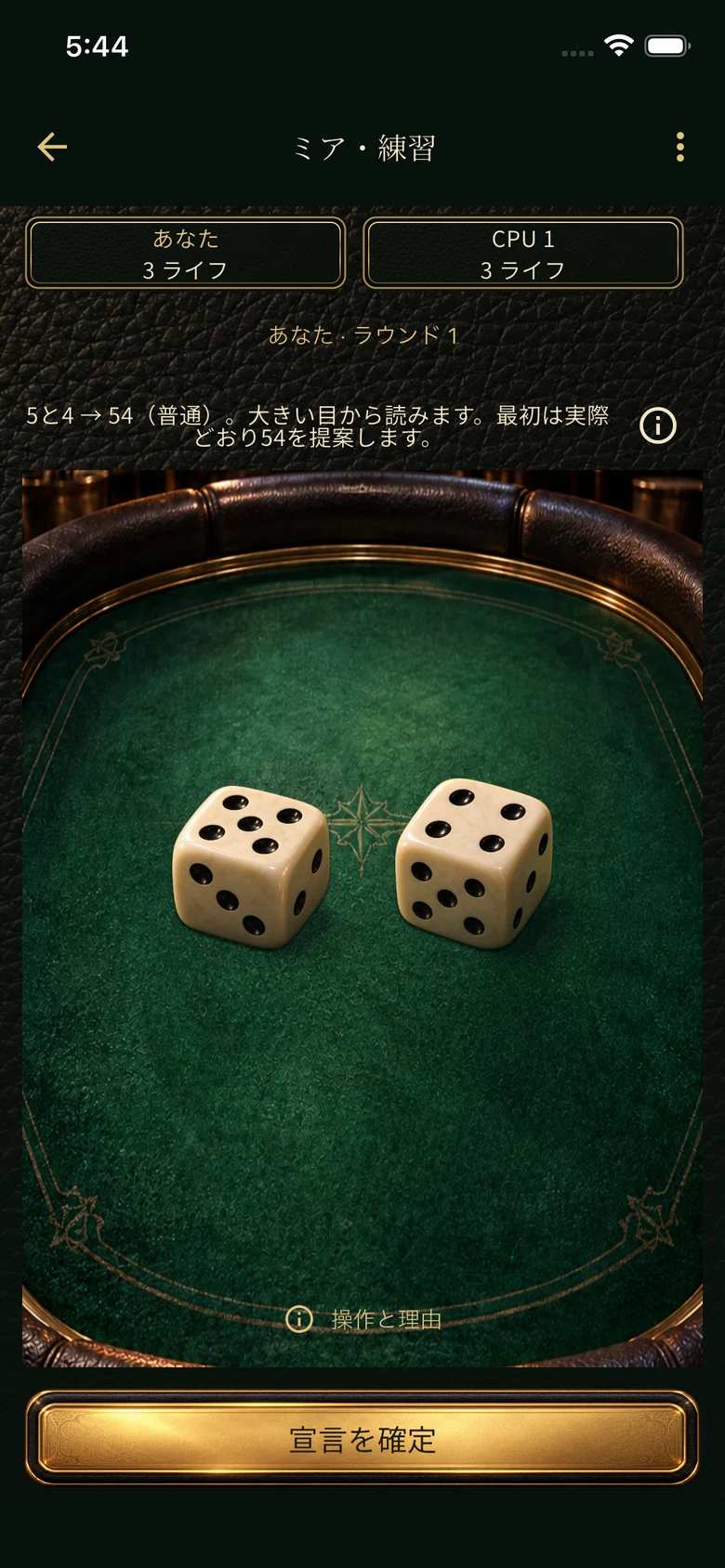
Open Choose a game → game details → Learn by playing. Tutorial progress is saved separately from regular matches and statistics.
Explore the difference between actual dice and declared rolls, practise accepting or challenging, and play against CPU opponents.
View Mia on the App Store See release information →