
Chicago rules & how to play
Ones score 100 and sixes 60. Choose holds and when to stop to avoid the lowest score.
Updated October 23, 2026. Based on the Version 1.1 implementation. Values illustrate standard or preset rules; your active settings take precedence.
Objective and setup
Play with 2–6 seats. Other seats are CPU opponents. Choose player count, individual CPU difficulty and rules before starting.
Reading the scores
A 1 scores 100, a 6 scores 60; other faces score their face. The hand 1,4,2 is 106; keeping the 1 and rolling 6,3 makes 163. The minimum is 6 from 2,2,2; the maximum is 300 from 1,1,1. The hand 4,5,6 is only 69.
Holds and roll limits
Roll all three dice first. Then keep or release dice and reroll the rest. Holding all three means keeping the score, not making an empty roll. The leader’s used roll count becomes everyone’s limit. A follower stopping early does not reduce the next player’s limit.
Losses for lowest scores
After all turns, every player tied for the lowest score takes one loss. Fewer rolls do not avoid a tied-lowest loss. Scores are compared within each round; they are not accumulated to decide the match.
Next leader and match end
The highest scorer leads next. Ties use fewer rolls, then earlier turn order. Three losses eliminate a player by default. The last survivor wins; simultaneous elimination of everyone is a draw.
Available settings
Choose 2–6 players, a maximum of 1, 2 or 3 rolls, and elimination after 2, 3 or 5 losses. Face scores stay fixed. The optional rule converting two sixes into a one is not used.
Example & practice
1, 6, 4 scores 164.
100+60+4=164. Keep 1 and 6 and reroll 4, or stop. If the leader stops after two rolls, every follower has a two-roll limit.
Does a tied-lowest score avoid a loss?
No. Every tied-lowest player takes one loss. If everyone is eliminated simultaneously, the match is drawn.
Practise Chicago by playing
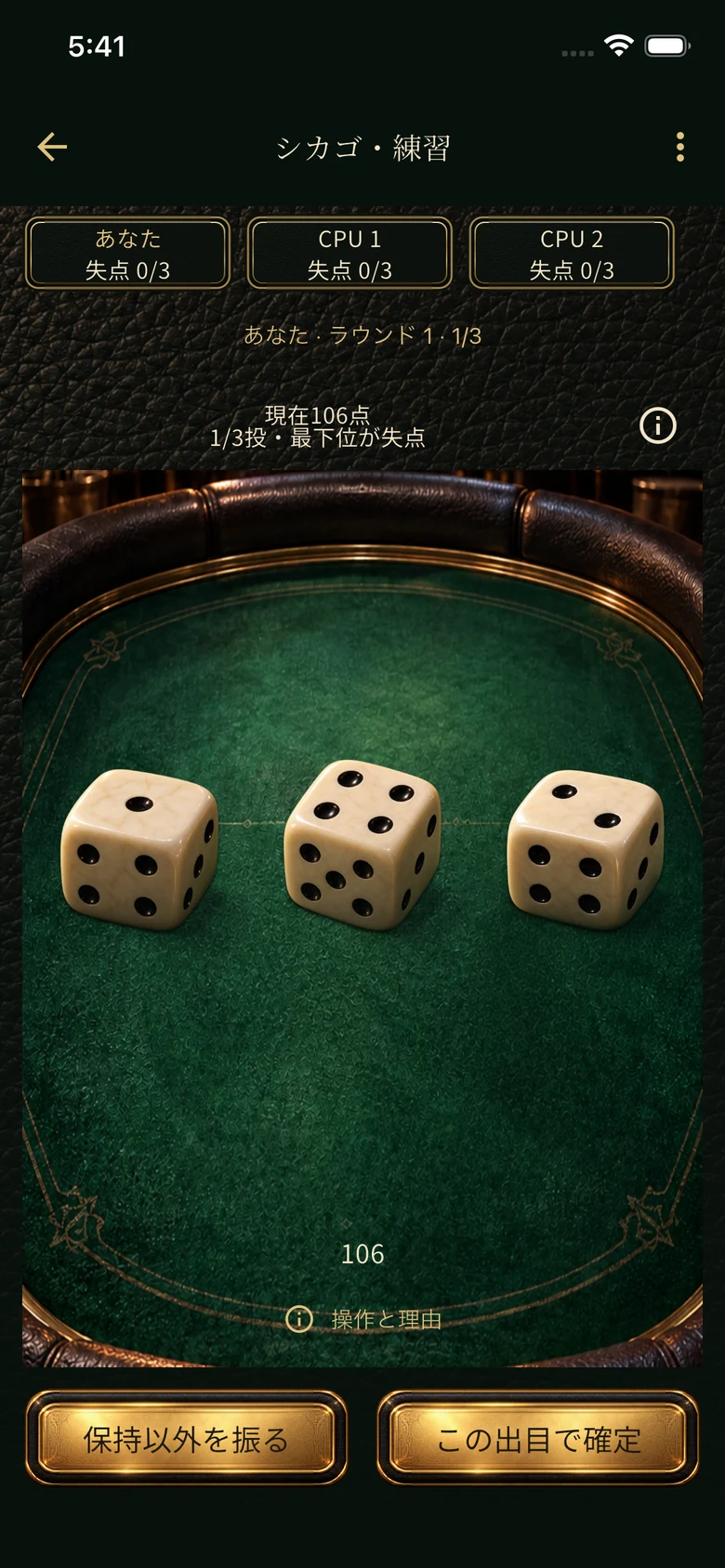
Open Choose a game → game details → Learn by playing. Tutorial progress is saved separately from regular matches and statistics.
Practise choosing which dice to keep and when to stop, then compete against CPU opponents.
View Chicago on the App Store See release information →