Hearts rulesThe art of taking less.
A high card is not always good news.
Dodge hearts and the queen of spades in this game for four.
Learn your first hand with concrete card examples.
Each captured heart is 1; ♠Q is 13.
Play another suit only if you have none.
That player takes all four cards.
In Hearts, less is more.
This guide covers four-player, 52-card Hearts with a 100-point threshold. Where variants differ, we specify the rule used here.
Hearts is an individual card game for four players. Deal all 52 cards, with no jokers, so each player has 13. There are no teams.
Only hearts and the queen of spades carry penalty points. Playing a card does not give you its points: the player who takes the trick receives them.
Each heart: 1 point
Queen of spades: 13 points
Every other card: 0 points
The game ends after a hand when anyone reaches 100 points or more. The player with the lowest total wins.
Card ranks
Within a suit, 2 is lowest and ace is highest. No suit is inherently stronger, and there is no trump suit.
Low → high. A “suit” is one of the four symbols: ♣ ♦ ♠ ♥.
Start by passing three cards.
Choose three of your 13 cards to pass to the designated opponent. Everyone passes simultaneously, so you cannot see your incoming cards before choosing your outgoing cards.
From hand 5, repeat left → right → across → keep.
One possible pass: ♣A, ♦K, and ♠Q.
♠Q is worth 13 penalty points. ♣A and ♦K are high cards that may take tricks. Passing these three, outlined in gold, is one way to reduce your dangerous and high cards.
This is an example, not a guaranteed best move. You may receive high cards in return.
A “hand” runs from the deal until everyone has played all 13 cards. Here, “passing” means exchanging three cards, not skipping a turn.
Four players, four cards, one trick.
One player leads a card, then the other three play one card each in turn. Those four cards form a trick. Playing the first card is called “leading.”
- Follow the suit led. If the lead is ♣ and you have clubs, you must play a club.
- If you have none of that suit, play another suit. The first trick has an extra restriction, explained below.
- The highest card of the led suit takes all four cards. A card of another suit cannot win, even an ace.
- The winner leads the next trick. After 13 tricks, the hand is complete.
Even with ♥A on the table, ♣K wins.
You lead ♣10. CPU1 plays ♣K and CPU2 plays ♣3. CPU3 has no clubs and plays ♥A. Clubs were led, so CPU1 takes all four cards with ♣K and receives 1 point for ♥A. CPU1 leads next.
Which card would you play?
Try a small practice hand. This is an illustrative scenario; it does not affect a real game or your statistics.
The table shows ♣10, ♣K, and ♥5.
CPU1, CPU2, then CPU3 have played. CPU3 has no clubs. You have five cards left.
Read the practice answers
① With ♣3, ♣A, ♠Q, ♦7, and ♥9, only ♣3 or ♣A is legal. Play ♣3 and CPU2 takes 1 point; play ♣A and you take 1 point.
② With ♦4, ♦7, ♠Q, ♥9, and ♥J, you have no clubs and may play any card. ♠Q makes CPU2 take 14 points including ♥5. A heart makes it 2 points; a diamond leaves it at 1.
The opening trick and breaking hearts.
Always open with ♣2.
After passing, the player holding ♣2 leads it. This also applies on no-pass hands. Everyone else must follow with a club if they have one.
Avoid penalty cards on the first trick.
Even if you have no clubs, you cannot discard a heart or ♠Q on the first trick when you have a non-penalty alternative. For example, with ♠Q, ♥3, ♦7, and no clubs, ♦7 is legal.
Exception in the rules used here: if you cannot follow suit and your hand contains only penalty cards, you may play one of them.
Hearts must be broken before you lead them.
Hearts are “broken” when any heart is played. Until then, you may not lead a heart, unless your hand contains only hearts.
For example, after the first trick, a player with no diamonds discards ♥4 on a diamond lead. Hearts are now broken and can lead later tricks. Playing ♠Q alone does not break hearts.
After 13 tricks, count the points.
Count the hearts you captured, then add 13 if you took ♠Q. For example, three hearts and ♠Q give 3 + 13 = 16 points. Each hand contains 26 penalty points: 13 hearts plus ♠Q.
| Player | Before | This hand | Total |
|---|---|---|---|
| You | 24 | +3 | 27 |
| CPU1 | 35 | +16 | 51 |
| CPU2 | 40 | +5 | 45 |
| CPU3 | 98 | +2 | 100 |
The game ends after this hand. You win with the lowest total, 27; reaching 100 does not win the game. If players tie for the lowest total, they share first place. If you are among them, the app records a draw.
Take every penalty card: shoot the moon.
If one player captures all 13 hearts and ♠Q, they score 0 for that hand and each opponent receives 26 points instead.
You need every penalty card, not every zero-point card. If another player takes even one heart, the moon attempt fails and normal scoring applies.
This guide and the Asomana app add 26 to opponents; it does not subtract 26 from the shooter. New players can focus on avoiding points before attempting a moon shot.
Find your way around the app.
Want to practise on your own? Asomana Card Games lets you play Hearts against three CPUs. This screenshot shows the three-card passing phase. Match the numbered markers to the explanations below. The screenshot uses the Japanese interface.
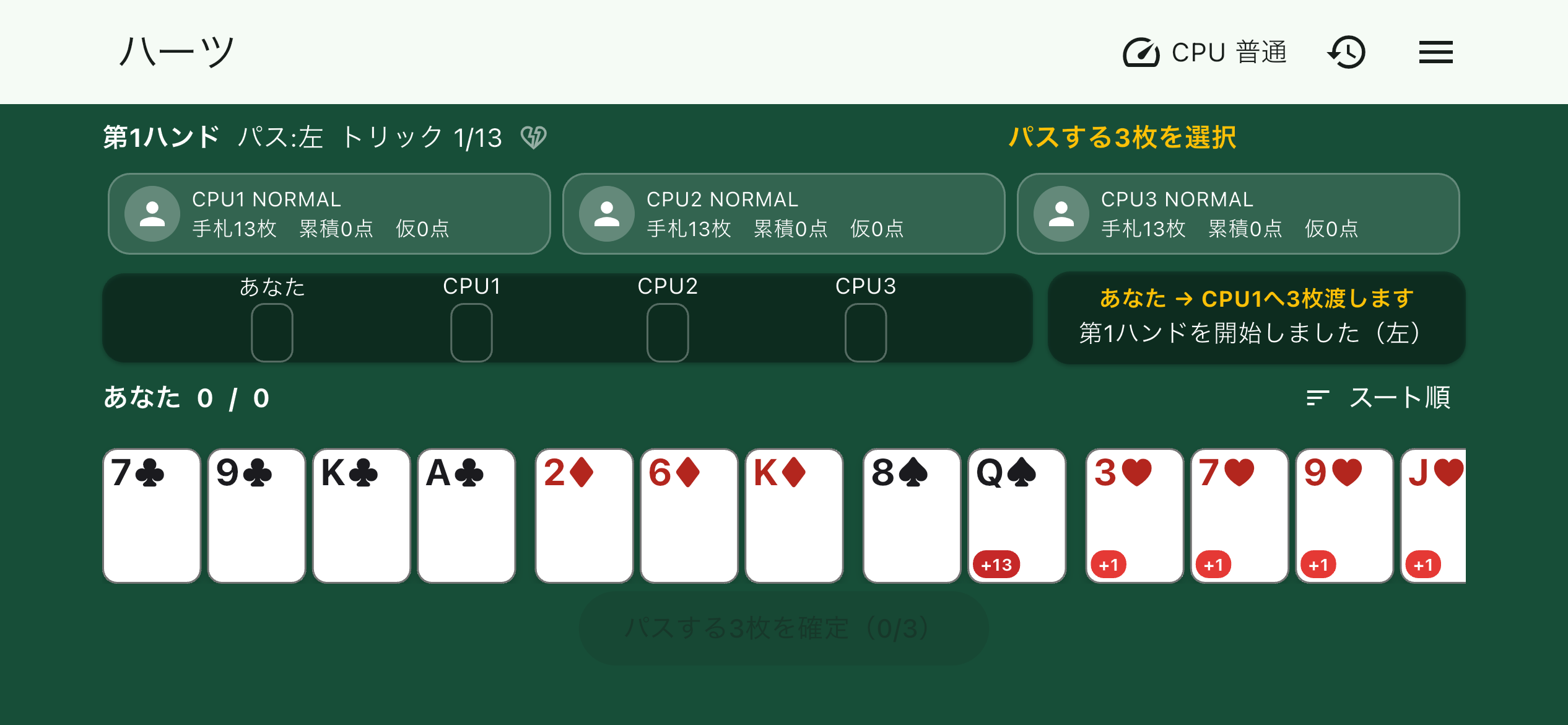
See the hand number, passing direction, and trick number.
Check each CPU’s remaining cards, total score, and provisional points for this hand.
See the cards played and what action to take next.
Select three cards to pass or one card on your turn. “You 0 / 0” shows your total / provisional hand points.
Select, then confirm.
- Tap three cards for the pass, then use the confirmation button below your hand. Review the received cards before starting play.
- On your turn, select a legal card and confirm with the play button. Tap an unavailable card to see why it cannot be played.
- While learning, use the play options at the top right to slow the CPUs and confirm trick results manually.
What you can change
Set each of the three CPUs to EASY, NORMAL, or HARD. During play, you can also adjust CPU speed, how trick results advance, and the display of danger cards and predictions.
Four players, the 100-point threshold, the passing cycle, penalty values, and moon scoring are fixed. They are not configurable variants. Use Save and exit in the menu when taking a break.
A few tips for your first game.
- Check the led suit first. Before comparing ranks, see whether you must follow suit.
- A lower card can help you avoid a trick. A card below one already played in the led suit cannot win. Leading a small card, however, is not guaranteed safe.
- Keep track of ♠Q. Until it has appeared, taking a trick with ♠A or ♠K may bring 13 points with it.
Do hearts in my hand count against me?
No. Only penalty cards in tricks you capture count against you. If an opponent takes a heart you played, the point belongs to them.
Can I follow with a card of the same color?
Follow the suit, not the color. Clubs and spades are both black but are different suits. If clubs are led and you hold one, a spade is not a legal substitute.
Do I have to beat the highest card?
No. If you must follow suit, you may choose any card of that suit. You do not have to beat the current highest card.
Does ♦J subtract points?
Not in this app. ♦J is worth 0. Variants found in other Hearts games may use different rules.
Put the rules into practice.
With Asomana Card Games, play Hearts on your own against three CPUs. Check why a card is unavailable and slow down the action. Try the moves you have just learned, one trick at a time.
Explore the app and availability →After the store release, download links will be available on the app page.