Concentration rulesRemember a card. Find its partner.
Turn over cards, remember their positions, and find matching ranks. Even an opponent’s turn can reveal your next pair.
Reveal one, then another.
Colors and suits may differ.
A mismatch passes the turn.
Collect the most pairs to win.
Concentration, also called Memory, is a game of revealing two cards and finding matching ranks. In the rules explained here, matching ranks form a pair regardless of color or suit.
A rank is the number or A, J, Q, K; a suit is ♠, ♥, ♦, or ♣. In this game you match ranks.
Lay the cards face down.
Shuffle and lay the cards face down without overlapping. No jokers are used. The app offers 24, 36, or 52 cards and one to three CPU opponents. The default is 36 cards against one CPU.
| Cards | Pairs | Ranks used in the app |
|---|---|---|
| 24 | 12 | A–6 |
| 36 | 18 | A–9 |
| 52 | 26 | A–K |
Each rank appears in all four suits, allowing two pairs of that rank. The app handles setup and turn order automatically.
Reveal, compare, remember.
On your turn, reveal one available face-down card, then a different one. Compare their ranks. You cannot choose the same card twice to form a pair.
| Result | Cards | Next turn |
|---|---|---|
| Same rank | Collect the pair | Same player continues |
| Different ranks | Return face down in place | Next player |
Match the rank, not the color.
For example, ♥7 and ♣7 are a pair. ♥7 and ♦9 are both red, but their ranks differ, so they do not match. Two aces or two jacks also form a pair.
A successful pair lets you try again.
After collecting ♥7 and ♣7, choose two more remaining cards. If you reveal ♦A and ♠3, they mismatch: return them in place and pass the turn.
What card would complete this pair?
Your first card is ♠5. Which of these cards would make a pair? This is an explanatory exercise, not a feature that reveals hidden cards in a real game.
Read all answers
♥5 — Correct. Both are fives, so they form one pair despite different suits. You take another turn.
♠6 — Not a pair. The suit matches, but 5 and 6 are different ranks.
♣K — Not a pair. ♣K needs another king.
Count pairs when the table is clear.
Count each pair as one. When every pair has been collected, the player with the most pairs wins. Card ranks are not added together as points.
A four-player, 36-card example
| Player | Pairs |
|---|---|
| You | 7 |
| CPU1 | 5 |
| CPU2 | 4 |
| CPU3 | 2 |
All 18 pairs have been collected. You win with seven. Tied leaders share first place; if you are among them, the app records a draw.
Practise with a comfortable deck size.
Tap cards to reveal them in Asomana Card Games. Start with 24 cards if you are new, then try 36 or 52 as you become more comfortable.
Choose one to three CPUs and set EASY, NORMAL, or HARD individually. Difficulty changes memory capacity and forgetting behavior. Watch the cards on their turns too.
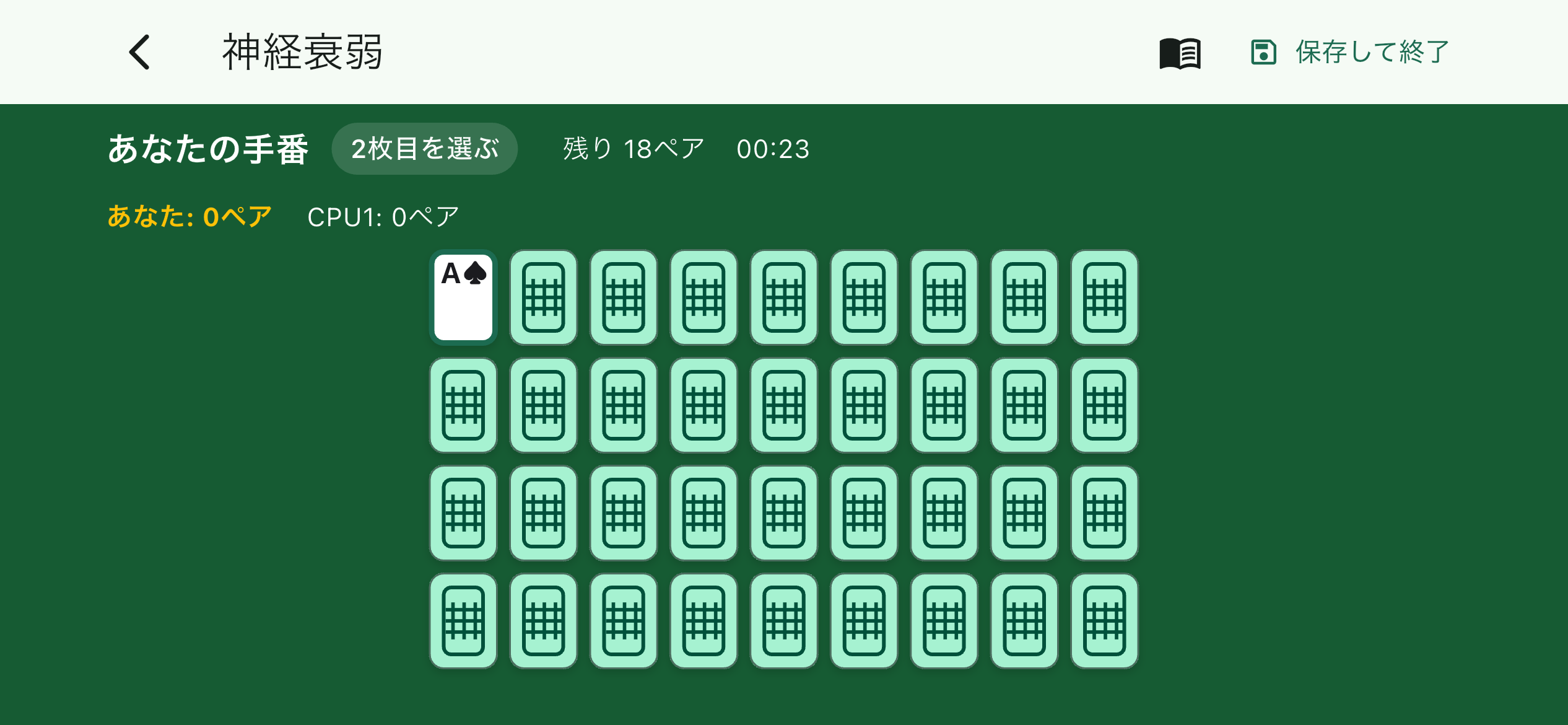
The left side shows whose turn it is and each player’s pair count.
The top shows remaining pairs and elapsed time.
Tap the face-down cards in the center. In this screenshot, ♠A is the first revealed card.
Use the book at the top right for rules or Save and exit to pause.
Watch your opponents’ turns too.
Remember a rank together with its position, such as “5 at the top left.” Opponents’ reveals are clues too. A known pair can be your next target.
Must both suits match?
No. Only ranks matter here: ♥7 and ♠7 form a pair.
Do mismatched cards move?
No. Turn them face down in the same positions, so remembering their locations helps.
Can I undo a turn?
There is no undo or redo in this game: seeing a card reveals information that cannot be undone.
Put the rules into practice.
Try what you have learned by moving real game cards in Asomana Card Games. Visit the app page for features and availability.
Explore the app and availability →