Sono rulesYour rows. Their columns. One shared board.
Two players share a board: one scores the rows, the other the columns. Every placement changes a line for both players.
Add up your five lines.
A diagonal touch is not enough.
The higher total wins.
Score the five lines in your direction.
Sono is a two-player game of placing cards on a shared 5×5 board. One player scores five rows; the other scores five columns. This guide explains the rules and scoring used in the Asomana app.
This is a game of scoring combinations on a shared board. Score the rows or columns assigned to you, regardless of who placed each card.
Ten cards each, five hidden on the board.
Use the 9, 10, J, Q, K, and A of each suit (24 cards), plus one joker. Deal ten cards to each player. Place the remaining five face down along the diagonal from top left to bottom right.
The app randomly assigns a dealer and the scoring directions. The non-dealer starts. Ten placements per player plus the five initial cards fill all 25 cells.
Place a card next to an occupied cell.
On your turn, choose one card and place it in an empty cell directly above, below, left, or right of an occupied cell. Face-down cards count as occupied. Diagonal contact alone is not enough.
Cell A (row 1, column 2) is next to the hidden card at row 1, column 1, so it is legal. B (row 1, column 3) has no occupied orthogonal neighbor initially. Once A is occupied, B becomes legal.
Revealing a hidden card changes the plan.
A hidden diagonal card is revealed once at least two of its orthogonal neighbors are occupied. Neither placed cards nor the initial hidden cards can be moved or swapped.
Revealing the top-left card
When the cells to its right (row 1, column 2) and below (row 2, column 1) are occupied, the top-left hidden card has two neighbors and turns face up. Use the new information to reconsider your line.
How much is this line worth?
A completed line is ♥9, ♦9, ♥10, ♦10, ♥A. It is two pair, and it also qualifies as all red and all number cards. What is its total score?
Read all answers
2 points — 2 is only the base score. Add the all-red and all-number bonuses.
5 points — There is another clan bonus. A counts as a number card in these rules, so add 3 for all number cards.
8 points — Correct: two pair (2) + all red (3) + all number (3) = 8 points.
One base combination, plus clan bonuses.
For each five-card line, score only the highest applicable base combination. Then add 3 points for each clan condition satisfied by all five cards.
| Example ranks | Base combination | Base points |
|---|---|---|
| — | None | 0 |
| 9, 9, J, Q, K | One pair | 1 |
| 9, 9, 10, 10, A | Two pair | 2 |
| J, J, J, 9, A | Three of a kind | 3 |
| J, J, J, Q, Q | Full house | 5 |
| 9, 10, J, Q, K | Straight | 5 |
| K, K, K, K, 9 | Four of a kind | 6 |
| K, K, K, K, Joker | Five of a kind | 10 |
This table lists base points only. Straights are 9–10–J–Q–K or 10–J–Q–K–A. The cards need not appear in that order on the board.
| Clan | Condition for all five | Bonus |
|---|---|---|
| All red | ♥ / ♦ | +3 |
| All black | ♠ / ♣ | +3 |
| All number cards | A / 9 / 10 | +3 |
| All face cards | J / Q / K | +3 |
Conditions such as all red and all number can apply together, each adding 3. A same-suit flush is not a base combination.
The joker works independently in each direction.
Four kings plus the joker make five of a kind (10), plus all face cards (3), for 13. In the intersecting line, the same joker may represent a different rank and suit to maximize that line’s total.
After all 20 placements, add the five lines in each direction. Rows totaling 8 + 1 + 3 + 5 + 0 = 17 beat columns totaling 3 + 2 + 0 + 5 + 1 = 11. Equal totals draw.
Try a move and consider both directions.
Play against one CPU in Asomana Card Games. Choose a card, choose a cell, then confirm the placement. Check which direction belongs to you and which to your opponent.
Choose EASY, NORMAL, or HARD CPU difficulty. Scoring and placement rules are fixed. There is no undo or redo; Save and exit lets you pause.
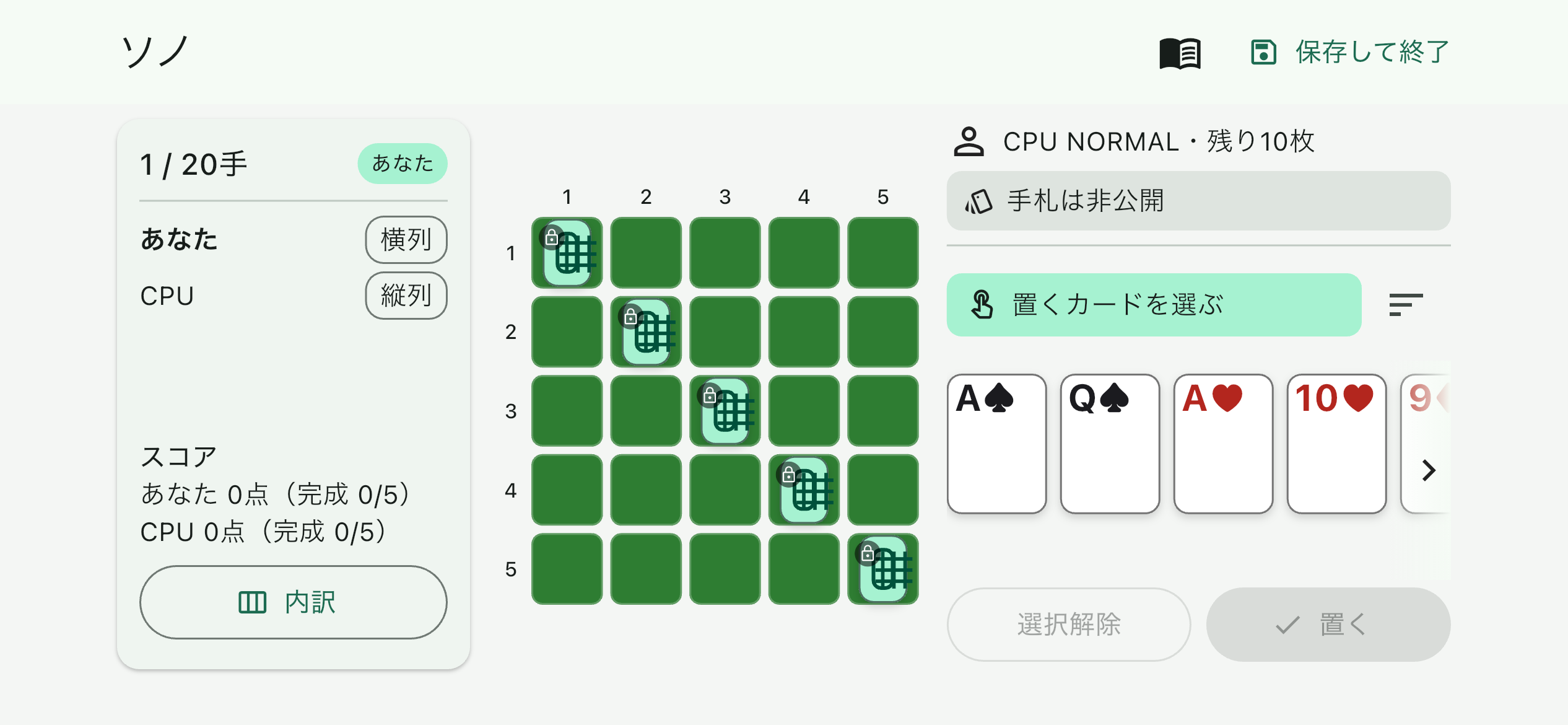
The left panel shows who scores rows and columns. You score rows in this screenshot.
The center is the 5×5 board. The five diagonal cards start face down.
Your hand is on the right. The CPU’s cards are hidden.
Use the breakdown at lower left to inspect scores and the lower-right button to confirm a placement.
Every card affects two lines.
Making a pair in your line may also help an opponent form a stronger combination. Check the opponent’s line crossing your chosen cell as well as your own.
Do diagonals score?
No. Only rows and columns score. The diagonal is where the initial hidden cards are placed.
Is ace a number card or a face card?
In this app, A, 9, and 10 are number cards; J, Q, and K are face cards.
Is there a flush score?
A same-suit flush is not a base combination here. Five cards of the same color earn 3 points for the all-red or all-black clan.
Put the rules into practice.
Try what you have learned by moving real game cards in Asomana Card Games. Visit the app page for features and availability.
Explore the app and availability →